Just a quick post that kills some questions from the previous post, and a report on just an overall wonderful REU project summer.
So let me start by the following: myself, and then Papadakis and Petrotou, and then us three jointly, proved the Lefschetz property for triangulated spheres (characteristic two in the case of Papadakis and Petrotou). This may be an unfamiliar word for someone not from algebraic geometry, but essentially, it is a property stating that Poincaré duality in certain manifolds coming from algebraic geometry (for instance, smooth projective varieties) is realized in a concrete way. Now you may think combinatorial Hodge theory à la Rota conjecture I proved with June and Eric, or positivity of Kazhdan-Lustig polynomials established by Elias and Williamson, this is much better. Because while those arguments relied on a known combinatorial trick by McMullen/de Cataldo-Migliorini, this one used an entirely new idea. First, let me state the theorem, without getting too technical:
We proved, given a triangulated sphere 


is an isomorphism.
Too explain some terms: Initially the face ring is too large to permit such a statement. It is only after an Artinian reduction, parametrized by choosing d linear forms, that the statement is true. And it is far beyond what algebraic geometers know and can prove, cool.
We generalized this to cycles later, meaning we actually obtained a Lefschetz in probably the biggest generality one could imagine in this setting. This implied all kinds of wonderful things. In particular, it implied the Grünbaum conjecture for simplicial complexes embeddable in some manifold. For instance, if
X is a simplicial complex that PL embeds into 
Now, there were several questions left, some of which are now solved.
Restricting the Artinian reduction The probably most exciting thing first: the result of myself, Papadakis and Petrotou only implied the Lefschetz property in a “generic” Artinian reduction. We could not say much more about how to choose the Artinian reduction explicitly, but for a program I have regarding the Hopf and Charney-Davis conjectures, I needed to restrict further.
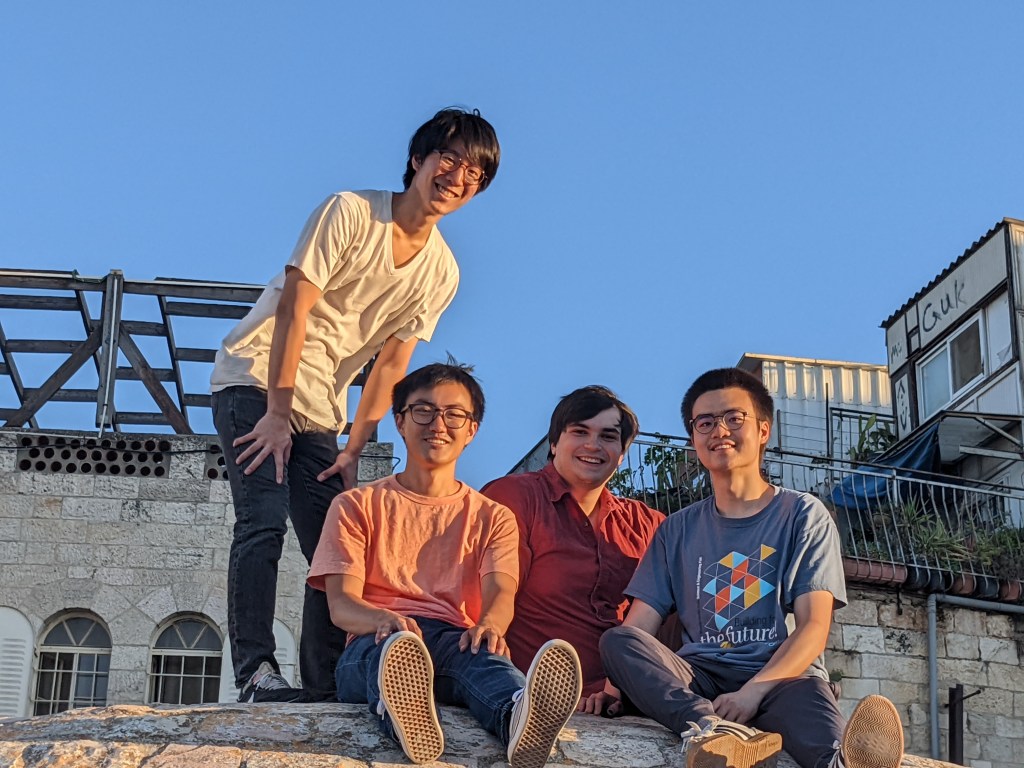
So, this summer, I had four REU students over in wonderful Jerusalem. Kaiying Hou (Harvard) and Daishi Kiyohara (MIT) and Daniel Koizumi (Utah) and Monroe Stephenson (Portland). I suggested putting a restriction on the types of Artinian reductions. And I had a bold conjecture that I only ever made to be provocative: we can choose points on the moment curve: If our sphere has n vertices, then we can choose 

Theorem The Artinian reduction induced by the moment curve implies the Lefschetz property.
Moment curves are just cool, and this result reflects a recent result of Luis Crespo Ruiz and Paco Santos, which essentially states that generic rigidity does not have to be generic, just moment curve general (I explained the connection between Lefschetz theory and rigidity earlier, remember?). Seems moment curves have got it all.
Anisotropy and reduced rings Now one key to the argument for the Lefschetz property is to understand how the Poincaré pairing restricts to subspaces. Recently I posted a somewhat simplified argument for the Lefschetz theorem, and in fact it led to another theorem I had long conjectured. First, Daishi and I proved the following theorem for m=p the characteristic of the underlying field, but then a general version was quickly obtained
Theorem Consider K any field, 


Edit: that does not work. We don't have full anisotropy in arbitrary characteristic yet...
That is just cool. Finally, I want to discuss lattice polytopes some more, and make up for the problems I solved with a more general one.
The curious case of Benjamin Button lattice polytopes Now all of these proofs and resultsare rather combinatorial. And what better than combinatorics? Arithmetic. A little at least. So any lattice polytope generates a semigroup algebra. And sometimes this algebra is standard. In this case, we (Papadakis, Petrotou, Steinmeyer and myself) prove the Lefschetz property (with the above trick, finally in general characteristic) for standard (= IDP) lattice polytopes, and solve just a bunch of conjectures. So now it remains to understand when this whole trick can work in general. So let me formulate a conjecture and call it a problem:
Problem Consider a commutative standard (generated in degree 1) graded algebra which is Gorenstein, its Krull dimension is at least one and finally, it is reduced (no nilpotent elements). Then it has an Artinian reduction that is Lefschetz and almost reduced.
 For a cup of coffee more
One thought on “Anisotropy in arbitrary characteristic, Lefschetz beyond positivity, moment curves and lattice polytopes (part 2)”