Misha Verbitsky facing extradition to Russia

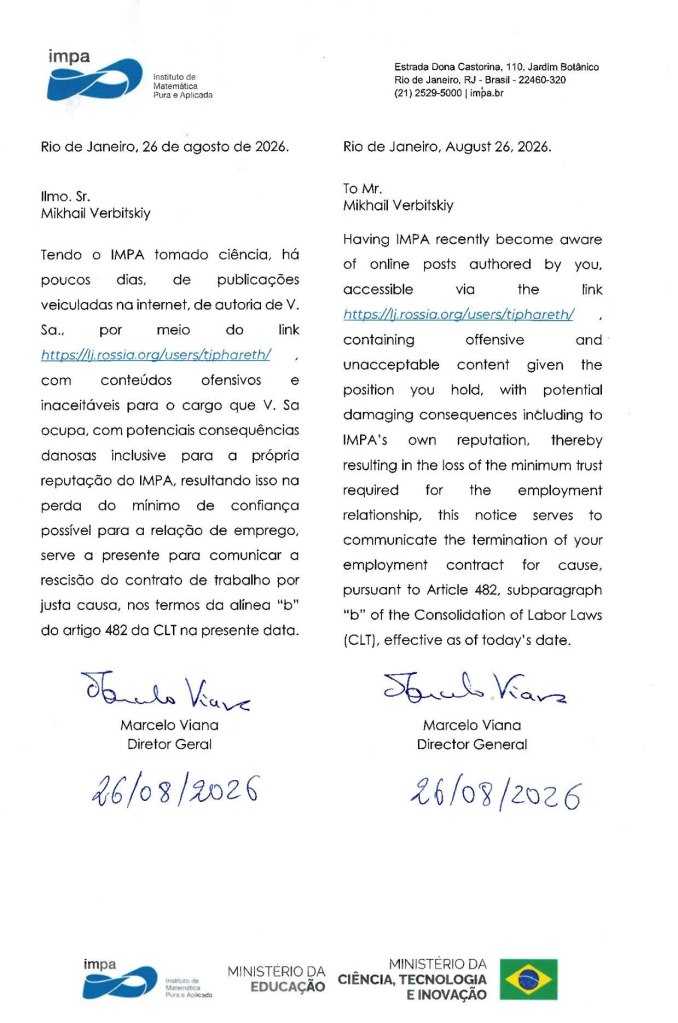
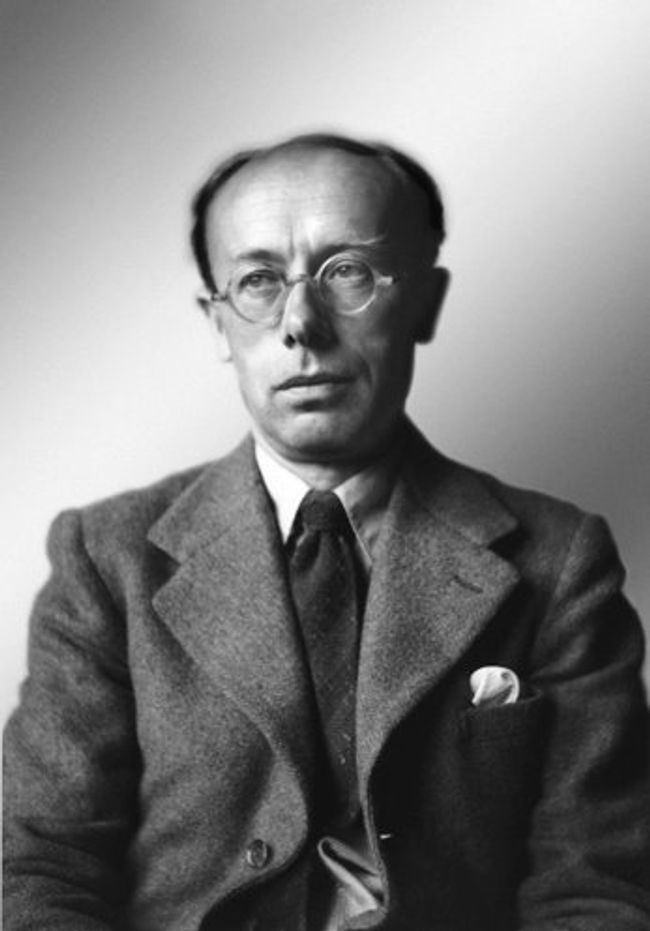
Misha Verbitsky, a distinguished mathematician and long-time public critic of the Russian state, has reportedly been detained at Yerevan airport on a Russian request.

Verbitsky is known not only for his mathematical work, but also for his uncompromising public writing: against war, against censorship, in favor of open culture and free expression. One need not agree with everything he has written to see the danger here. The Russian charges against him arise in the context of political speech and dissent. Extradition to Russia would therefore place him at grave risk.

Armenia should not hand him over. At minimum, Verbitsky must have immediate access to lawyers, independent observers, and a fair procedure in which the political nature of the Russian request is taken seriously.

This is urgent. Please circulate reliable information, contact academic and human-rights networks, and ask Armenian authorities not to extradite Misha Verbitsky to Russia.

For questions, please contact his daughter, Sima

Singularities from bug to feature: Homeomorphisms over K, neighborhoods and waists

There is nothing new in this post. It is the sort of thing that most people would probably call folklore or obvious, but then again, sometimes it is cool to write it down. And who knows, perhaps someone finds it useful. Also… let’s face it, a lot of PL/combinatorial topology is a mess, and things that used to be well known get lost.

There are, on occasion, obvious concepts which lack a name. Perhaps because they have not proven useful yet. But then again, they are so very natural, they deserve to be discussed somewhere.

If X and Y are two topological spaces, perhaps manifolds, perhaps something else, then one remembers from topology what it means for them to be homeomorphic. We also know what it means to be PL homeomorphic1, that is when the homeomorphism isn’t merely continuous, but piecewise linear. Still, it pays sometime to go back in time and look at the history of the subject. Incidentally, let me mention this marvelous book on the Hauptvermutung and its history I found recently by the late Yuli Rudyak2.

Continue reading

Hauptvermutung, Tietze’s dream and the importance of checking your references

Recently, we got back several referee reports for this paper here (to appear in Inventiones mathematicae, see here) which were quite positive (well, the comments were “the construction is genius and it works, but the exposition is quite messy”; I choose to take it as a compliment), which made me very happy because it is a very classical conjecture with some nice implications. And seeing people who took their time to understand the construction (and wade through my horrible writing, because the “messy” is certainly my fault) made me quite proud…

Speaking of, though, classical conjecture…. well one part was Oda’s. That was fine. The other conjecture we solved was “Alexander’s conjecture”, named after James Waddell Alexander. Everyone kept calling it that, and Alexander certainly worked on related problems and proved something weaker in a 1930 paper (building on work of Max Newman, who, another cool fact, is best known for becoming a codebreaker later).

Continue reading

Teaching in the Spring, CAGe and more

Firstly, for a while now, Harald Helfgott, Vasiliki Petrotou, Arina Voorhaar and myself have been organizing CAGe, a bimonthly (the bimonthly that happens roughly every 6 weeks) miniworkshop at IMJ in Paris. The idea was to have this instead of a seminar so that the visiting speakers could also have interesting talks to join, and so that there would be more of a theme each time. Next time is March 4, with Evita Nestoridi, Carsten Peterson and Jacinta Torres. Enjoy and join!

Secondly, after settling down at IMJ and getting a couch and carpet for my office, I will be teaching a course with Harald in the spring, on spectral graph theory. Find it here.

Continue reading

De Rham but not de Rham: (mixed) volumes for semigroup algebras and more!

Wanna hear a cool thing we realized while exploring lattice polytopes, but that took us much further?

So you know how in a smooth manifold, we can think of the fundamental class by integration over the manifold; that’s just de Rham cohomology of course, and we come to think of the fundamental class as something related to volumes and measures. This beautiful picture is something very geometric, in the end, one might think.

Continue reading