I am currently visiting my friend Paco Santos in Santander, Cantabria, and things are off to a rocky start. As I enter his office, he challenges me to a duel.
“I hold a theorem” he says. And after thinking for a few seconds, he adds: “I am also holding a corollary about symmetries”
I am stumped. It is early, and I lack the mental fortitude of morning coffee. I have to think…
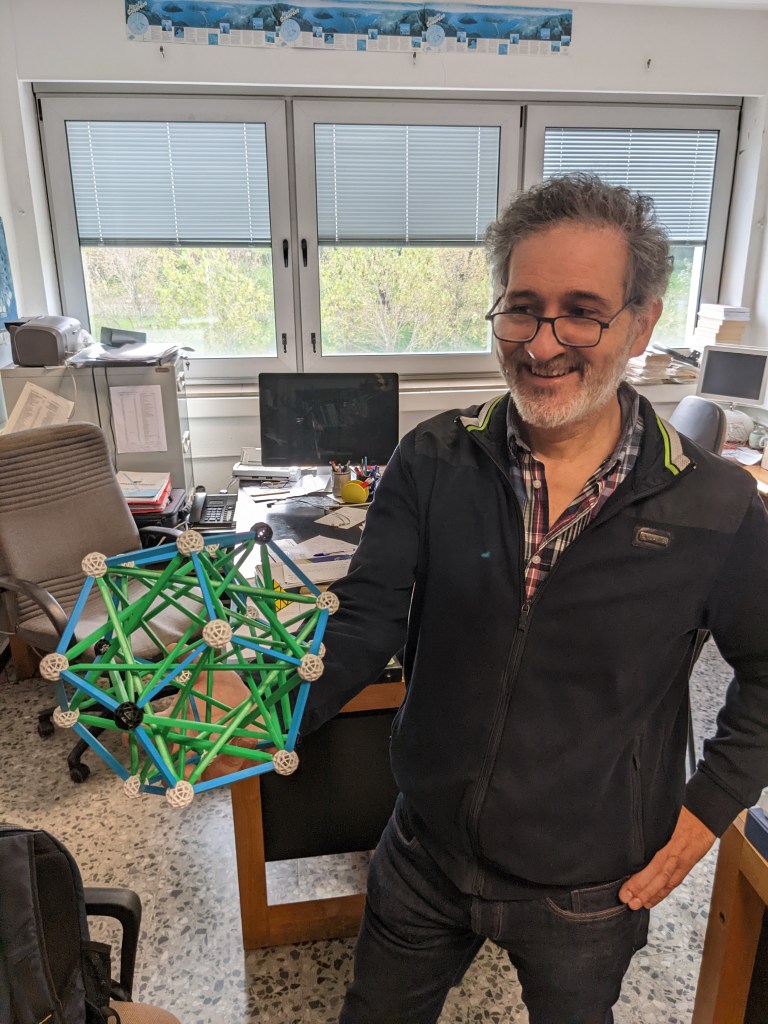
The answer: the vertices of the dodecahedron can be partitioned into 5 regular tetrahedra (these are the green diagonals).
Now, you can use this fact to compute the group of symmetries of the dodecahedron! Well, clearly you can take the vertices of one of the tetrahedra to itself. That is the alternating group 

 For a cup of coffee more