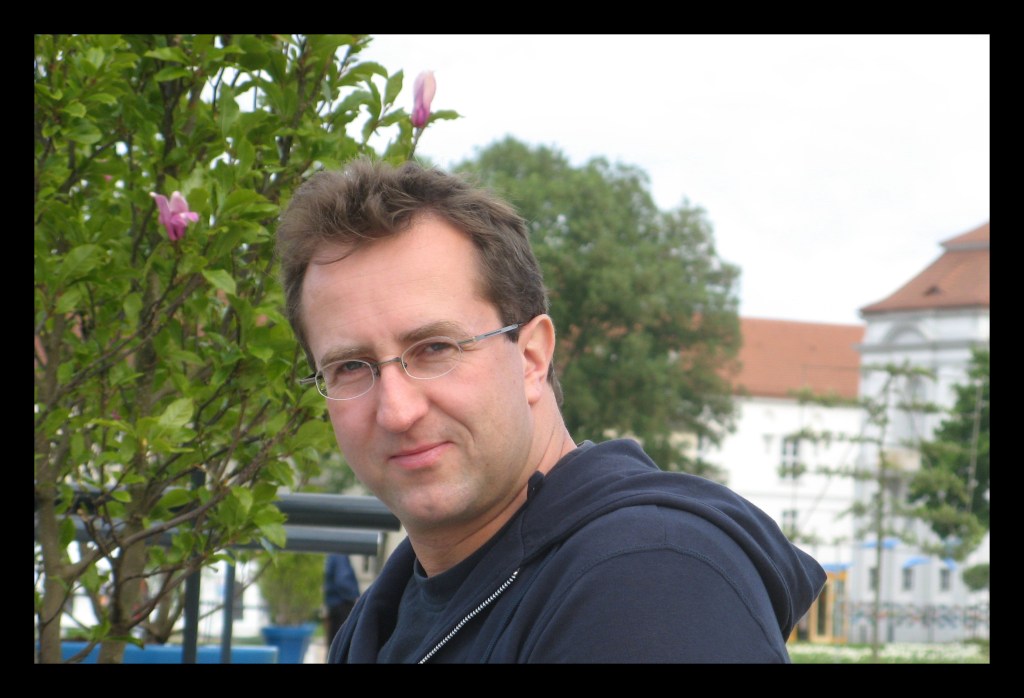
I was sad to learn that my friend, coauthor and academic brother Frank Lutz passed away a few days ago, way too soon. You can see the announcement here. I want to write a bit about his mathematics here, away from just going over his CV.
What impresses me most in scientist, and what in my eyes distinguishes a good scientist from a great one beyond talent, I think it vision and perseverance. This may not always be a mark of success, as the vision may not be a popular one. But a vision and a perseverance to pursue it carries a voice and legacy beyond simple popularity.
Frank was such a mathematician. His vision was explicitness, concreteness of construction. His desire was to give any paradoxical, any counterintuitive phenomenon to a clear-cut example. His main fascination then was with topological spaces, and combinatorial properties. His desire was to give other mathematicians clear examples and constructions to refer to, to manipulate, to experiment with.
He constructed explicit models of the Poincaré homology sphere with Anders Björner, discussed the practical aspects of sphere recognition with Michael Joswig, Davide Lofano, and Mimi Tsuruga (the latter two were his students) and described randomized algorithms to find Morse functions with Bruno Benedetti, among many other results.
He was also a main contributor to the electronic repository eg-models, a collection of concrete examples for a variety of phenomena in combinatorial topology.
And he never stopped until he had found the most transparent solution. I remember that over months, he pestered me to explain the construction of a collapsible manifold that is not a ball. I am not the most patient person, and often rebuffed him quite rudely when I thought my answer should make it obvious. But he wanted every single move of the collapse, on paper, to check… and despite me being quite rude and impatient (an issue I try to deal with) he persevered and, over several meetings he made me have with him, extracted an answer that made him happy.
His commitment to his vision was simply awe-inspiring. I will miss him.

 .
.

 For a cup of coffee more