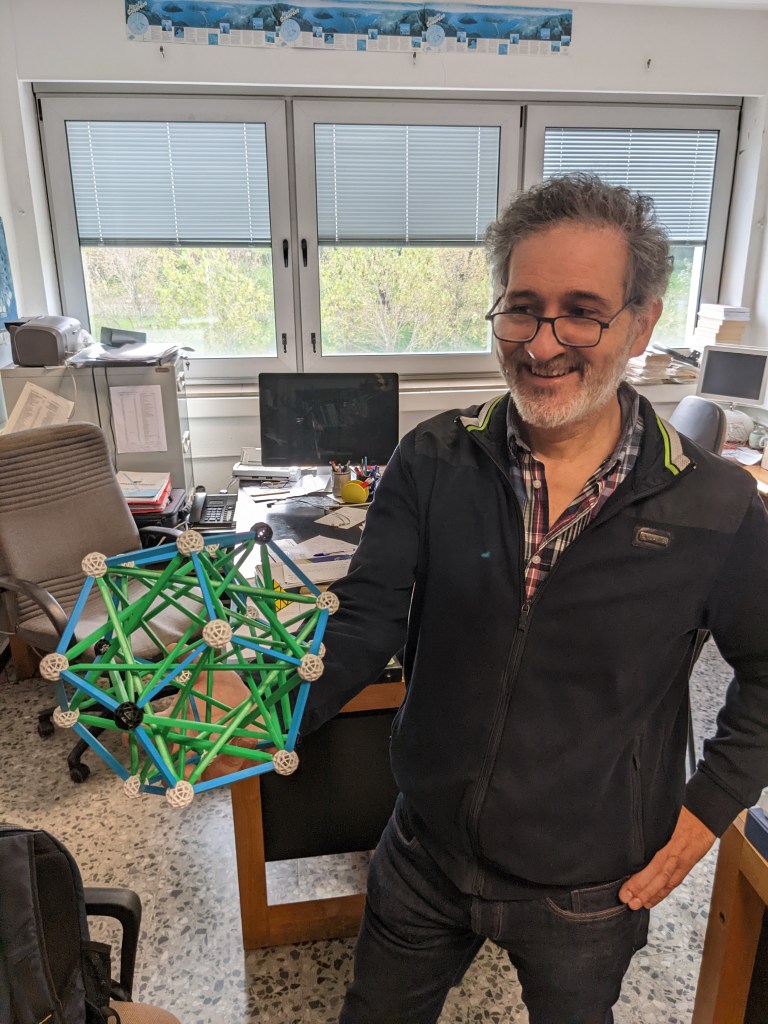
I am currently visiting my friend Paco Santos in Santander, Cantabria, and things are off to a rocky start. As I enter his office, he challenges me to a duel.
“I hold a theorem” he says. And after thinking for a few seconds, he adds: “I am also holding a corollary about symmetries”
I am stumped. It is early, and I lack the mental fortitude of morning coffee. I have to think…
The answer: the vertices of the dodecahedron can be partitioned into 5 regular tetrahedra (these are the green diagonals).
Now, you can use this fact to compute the group of symmetries of the dodecahedron! Well, clearly you can take the vertices of one of the tetrahedra to itself. That is the alternating group . But you can also take any tetrahedron to any other tetrahedron, leading to conjugate copies of the same group. Those are 5 copies. Hence, what you obtain finally is the alternating group .
A while ago, Janos Pach told me a question of Peter Maga originating in topological graph theory: Given an arrangement of curves in the plane, can they be realized as geodesics? Due to my Nikolai Mnev‘s universality theorem (and earlier work by Ringel), it is badly impossible to linearize them (stretch them to line segments), even if we assume that any two curves intersect at most once and at that point transversally, that is, if they form a system of pseudo-segments. However, Janos “just” wanted each curve to be a shortest path.
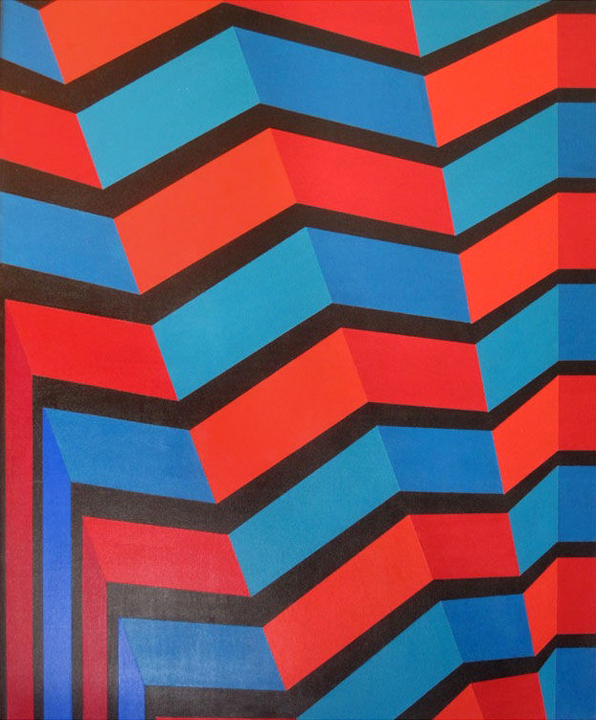
Artwork by Herbert BusemannJanos Pach (by János Szántó)Николай Мнёв3 pictures that lie on more than 3 common lines
This had been proven if the segments extend to infinity by Herbert Busemann (who, as I found out, was also an accomplished artist) and so Janos asked whether it was true in general; this of course would be much more reasonable than the realization along lines (note that the space of all metric spaces with given geodesics would be a disk, rather than the arbitrarily nasty deformation space that Kolya proved whe have when looking for arrangements of real lines.)
So, now we want each line to be the shortest, no two points along it should have shortcut somewhere else. A reasonable request; having dabbled in city planning (read: I played Cities: Skylines like, twice) I imagine it must be the worst nightmare of every real estate developer if the carefully named street is not actually used because a detour using other streets is shorter. (Edit: Conferred with a friend who does spatial planning for a German metropolis. It is not something that keeps him up at night. As with all of us, it is depression and anxieties that keep us up and night. And the decision to have coffee in the evening.)
Jokes aside, this can have real applications, as knowing which routes are shortest (geometer speak: knowing the geodesics and shortest paths) makes planning a route considerably easier (CS speak: faster to compute).
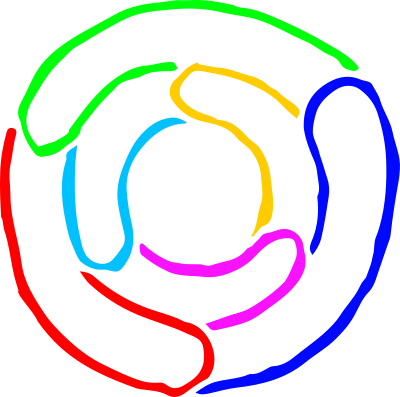
Alas, it turns out to be wrong, and Janos and I found that there are examples where the carefully named and arranged streets are not the shortest. And the aesthetically pleasing example you see here:
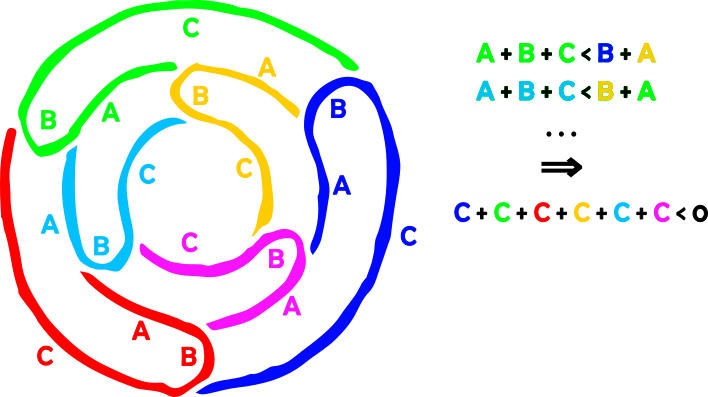
It is not hard to see that we cannot give a length metric to this graph such that each of the colored lines is a shortest path; here is the calculation:
And as streets should not have negative length, we are out of luck.
Disclaimer: updates to the post were sponsored by an anonymous professor at Rényi Institute
I was listening to a marvelous talk by Jean-Pierre Bourguignon today, about generalizations and (geo)metric meaning of scalar curvature, and Misha Gromovs thoughts on the subject. Essentially, just like Alexandrov and Gromov and many others gave us metric understanding of sectional curvature, and Sturm and Lott-Villani and many more gave us metric ways of thinking about Ricci curvature, Misha is at it again to do the same with the weakest notion of curvature.
Jean-Pierre Bourguignon (I will take a less formal picture of him tomorrow)Misha Gromov (this picture seems informal enough)
One of the goals would be to understand polyhedral spaces from the viewpoint of scalar curvature. In this context, Misha asked me to give a reference for the following statement: Given fixed and any , there is a finite number of combinatorially distinct -polytopes all whose dihedral angles are all smaller than I will write more about this and scalar curvature later, but for now I am stealing a format from Gil’s blog and ask: Did I have a chance to find such a reference, or do you find examples that make such a statement hopeless? And what can you choose safely?
While I am at it, let me add another question for your intuition: Can you deform a polytope such that all dihedral angles do not get bigger? What deformations can you find? More on this subject, and some partial answers to the questions above, later.
I visited Prague last week to distract myself after my cat Misha died way too early (he was only 6). And it was quite an amazing visit, in every way. Something about it made me forget my worries (can you guess what?)
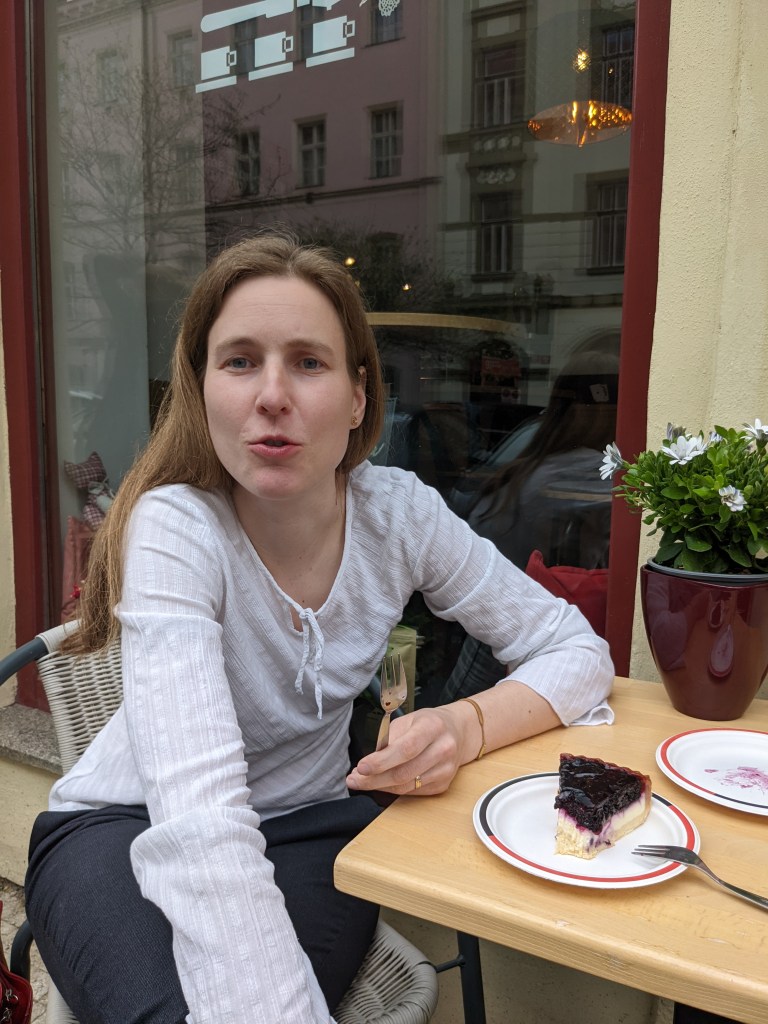
More importantly, I met once again my very first postdoc Zuzka (Patakova) as well as my good friend Martin (Tancer). As is long-establish precedent among postdocs, Zuzka had to share some of her blueberry cake with me. But we also made some amazing advances, proving that realizing simplicial 4-polytopes is at least as hard as existential theory of the reals as well as investigating cool questions about spaces with prescribed geodesics.
Zuzka and a fully intact blueberry pie
Let me close with some overdue congratulations: My former postdoc Gaku Liu (now a professor in University of Washington) extended some joint work of him, Michael Temkin and me to prove an old conjecture in polytope theory: Every sufficiently large dilation of a lattice polytope admits a unimodular triangulation.
Misha TemkinMy former postdoc Gaku
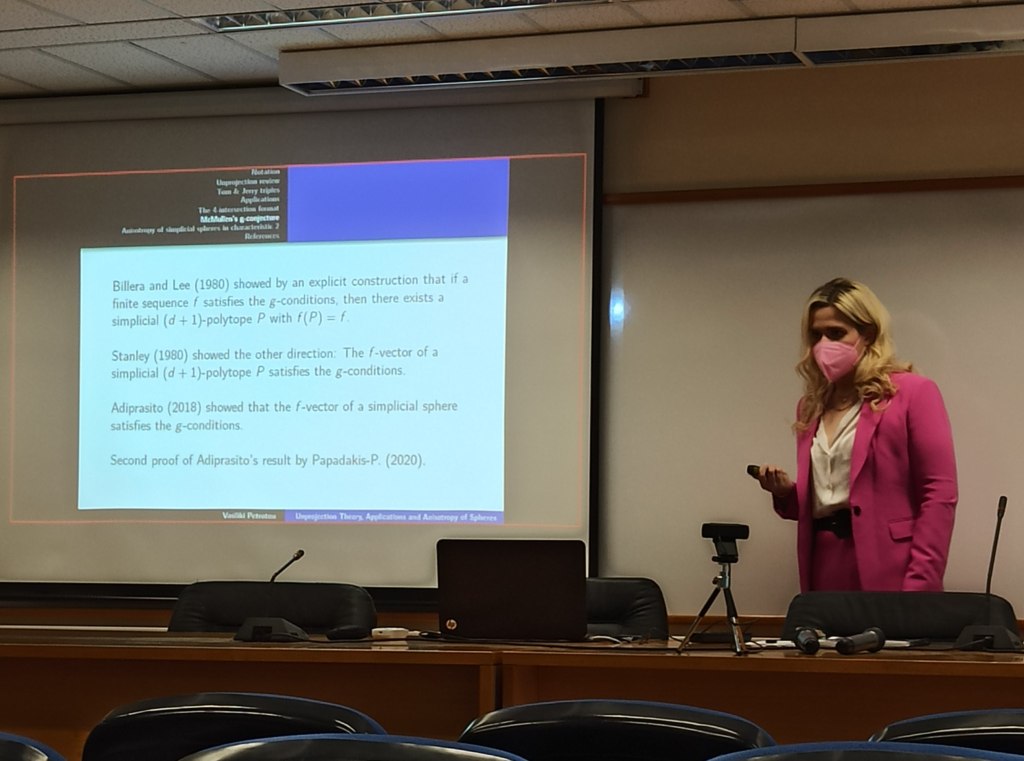
Oh and my coauthor Vasso has succesfully defended her thesis. She will be joining my team in the fall to work on my new ERC project. Congratulations Gaku and Vasso!
I forgot to mention: Paolini and Salvetti proved the -conjecture for affine Artin groups a while ago, congratulations! It is a very exciting result in combinatorics and topology!
Giovanni PaoliniMario Salvetti
Plus, Toufik Mansour is conducting interviews with renowned combinatorialists, including my friends Gil and Igor. Ah and also me.






 and any
  , there is a finite number of combinatorially distinct
  I will write more about this and scalar curvature later, but for now I am stealing a format from Gil’s blog and ask: Did I have a chance to find such a reference, or do you find examples that make such a statement hopeless? And what





 -conjecture for affine Artin groups

 For a cup of coffee more