Jewish Poker

For quite a while the two of us sat at our table, wordlessly stirring our coffee. Ervinke was bared. All right, he said. Let’s play poker.

No, I answered. I hate cards. I always lose.

Who’s talking about cards? thus Ervinke. I was thinking of Jewish poker.

He then briefly explained the rules of the game. Jewish poker is played without cards, in your head, as befits the People of the Book.

You think of a number, I also think of a num­ber, Ervinke said. Whoever thinks of a higher num­ber wins. This sounds easy, but it has a hundred pit­falls. Nu!

All right, I agreed. Let’s try.

We plunked down five piasters each, and, leaning back in our chairs began to think of numbers. After a while Ervinke signaled that he had one. I said I was ready.

All right, thus Ervinke. Let’s hear your number.

Eleven, I said.

Twelve, Ervinke said, and took the money.

I could have’ kicked myself, because originally I had thought of Fourteen, and only at the last moment had I climbed down to Eleven, I really don’t know why. Listen. I turned to Ervinke. What would have happened had I said Fourteen?

What a question! I’d have lost. Now, that is just the charm of poker: you never know how things will turn out. But if your nerves cannot stand a little gam­bling, perhaps we had better call it off.

Jewish Poker by Ephraim Kimshon

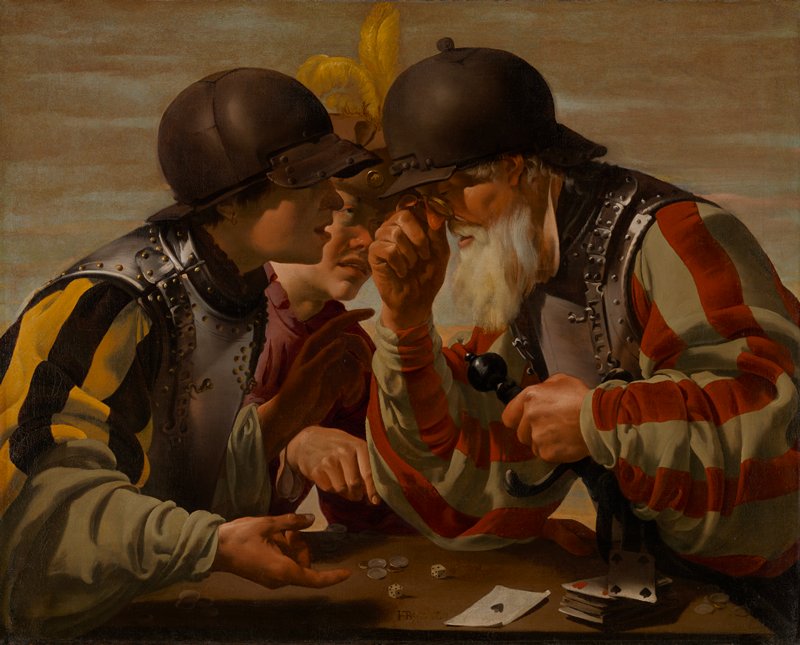
What just happened? by Hendrick ter Brugghen
Continue reading

At least two 2-associahedra, QFT and the importance of taking a bird’s eye view

A useful idea to study an object is, it turns out, not to just consider the object but an entire space of objects like it. Consider, for instance, the situation in which you want to simplify an object to one you understand (like in the solution of the Poincaré conjecture) or when the space is naturally evolving over time (like spacetime): in this case, it is often easier to understand the space of spaces, rather than the space itself, as difficulties like singularities can vanish once you have taken a broader, bird’s eye view.

I want to discuss a specific case of this, based on a great talk Daria Poliakova gave in our seminar. If you don’t like it, well…

Continue reading

Angles, gherkins, polytopes and a sociological experiment

Let me start by admitting that this blog is a social experiment to see how long people take to ask me “what the fuck?” (I am kidding)

(seriously though, I am always a bit of chaos. Nothing out of the ordinary, though admittedly a bit sick and depressed at the moment. Thank you and all the love for caring y’all. Love you all 😉 )

Now, on to the other stuff: At some point in my life, I was doing my PhD and being an all around useless student (I spent most of my office computer hours watching Game of Thrones and Gossip Girl; this is not to say I did not work, but I usually cannot sit in an office chair and work. I paced around outside. Honestly I feel most time was wasted because I was anxious about seeming to work and ending up watching series rather than going out and thinking my own way), my advisor PhD Günter Ziegler and I looked at a gherkin and said: this is going to make a fine math paper. Anyway, tonight I was visited by three ghosts, and they told me a tale.

Continue reading

A fact and a consequence

I am currently visiting my friend Paco Santos in Santander, Cantabria, and things are off to a rocky start. As I enter his office, he challenges me to a duel.

“I hold a theorem” he says. And after thinking for a few seconds, he adds: “I am also holding a corollary about symmetries”

I am stumped. It is early, and I lack the mental fortitude of morning coffee. I have to think…

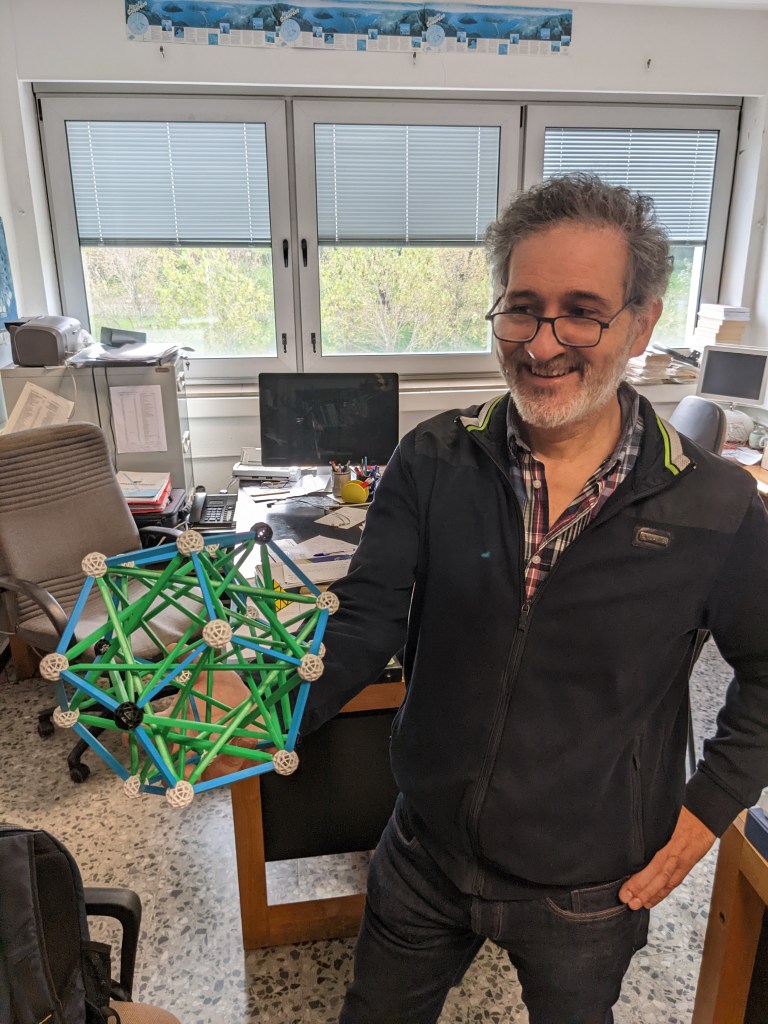
The answer: the vertices of the dodecahedron can be partitioned into 5 regular tetrahedra (these are the green diagonals).

Now, you can use this fact to compute the group of symmetries of the dodecahedron! Well, clearly you can take the vertices of one of the tetrahedra to itself. That is the alternating group A_4. But you can also take any tetrahedron to any other tetrahedron, leading to conjugate copies of the same group. Those are 5 copies. Hence, what you obtain finally is the alternating group A_5.

Kustin-Miller unprojection, degree maps and post-nuclear relationships of the future

Dear Diary,

yesterday I heard an amazing talk by Eva Philippe and I will get back to that, as well as related questions I am thinking about with Sergey Avvakumov (who is on the market btw., though I do not expect trouble there cause he is doing great things) and Mark Berezovik (who I got to Jerusalem to finish his masters in exile. Study in exile. Interesting that we do that again).


Anyway, dear diary, it reminded me of something many years in the future.

You see, in 35 years I am going to sit my second grandchild on my lap. The bright one. She was always the bright one. So many questions.

And so, after helping my first, my grandson, build a gauntlet for the mutated squirrel warriors, I will sit her down. Spit the iodine tablet into the bucket and sigh, thinking about the best advice. She is starting to get interested in relationships, and she is asking me.

“Grandpa, I want to ask about pairings”

she begins, and my bioengineered squidheart sinks. Not that one.

Continue reading

Kabelsalat, Schoolification, science education, flattening PL maps and Ronly Honly Bing

First bullet point: There is an interesting analysis of the secret deals that led to the war in Ukraine at the moment by the New York Times, as well as an account of the Trump administration involvement.

This post is brought to you by the letter A for anger issues, and the failed attempt to find an HDMI cable. Why is it that usually there are enough of them to choke two species into extinction, rid Paris of her rat-issues and still have enough for the Praelatura Sanctae Crucis et Operis Dei to flagellate themselves biweekly, but now I cannot find a single one.

Second: Something is rotten in the state of Denmark. Ok, I am being overdramatic; though if I was talking about the level of paranoia this country sometimes presents when faced with youth whose skin is not piggy-pink, that could well be appropriate.

I am also not referring to royal family affairs and the queen’s dental care.

Also, the issue is not really restricted to Denmark. I just really wanted to quote Marcellus.

What I am referring to is an increasing effort to make university a school. And as someone who hated school, let me say:

Continue reading

The Medici bitch and quantifications in commutative algebra

As forces and probabilities greater than I decide my location in the next 48 hours, let me briefly profess my love for Samantha Morton as Serpent Queen. It is beautiful to watch a sly smile creep across her lips as schemes come to fruition, and perhaps more importantly, how hardships are quickly incorporated into yet another scheme.

Isn’t it nice to scheme in France. Muhahaha

Indeed, isn’t it most interesting when things fail? When we invariably hit our nose, the rock rolls down the hill again. For we can scheme how to roll it up next time. Blood in the streets and all that.

Continue reading

Shhhh. Secrets, entropy and dyslexia

Lefty got something to show and tell you

So, say you have some secrets you desperately want to air, but not so desperately that everyone should know. And you are also a little weird, so you only want them to be able to know if they get together and work out the clues. (Oh dear, it sounds like an exhausting gamenight).

Then you have a secret sharing scheme. Specifically, you got yourself into a situation where you have a set P of people, a set C of subsets of P (lets call them conspirators) and a collection of secrets S and Hints H. What you want to do is for a set of people to figure out the information if it contains one of the c in C. Think of it like that Simpsons episode where every single Flying Hellfish was needed to assemble treasure; or think of a more realistic example of a company or agency in which vital information is only accessible by a group. That sort of thing.

Continue reading

Convex sets can run, but cannot hide. Also, Parseval-Rayleigh identities in characteristic two and Lefschetz properties for monoid algebras.

Let me start with some overdue news, finally released after passive aggressive messages and open bullying. And England’s prime minister got usurped by lettuce. I promise I will start making more sense now.

Erdős and Szekeres famously showed that every set of general position points in the plane contains a large subset of points that is in convex position. And quite recently Andrew Suk improved this so much, that by now we have an essentially tight bound on how many points we can find in convex position, at least in the plane. This was improved a little furtherby Holmsen, Mojarrad, Pach and Tardos here.

But some found that all too plain, and pointed out that in higher dimensions, convex sets could have an even harder time hiding, and that there could be substantially larger convex sets in higher dimensional pointclouds. Alas, noone could prove this until recently, when my friend Cosmin provided, in joint work with Dmitrii Zakharov the first substantial improvement in dimension 3. Congratulations Dima and Cosmin (and see you soon, looking forward to a wintery northeast).

Dmitry Zakharov and Cosmin Pohoaţă in New York

Secondly, our (announcement) preprint on the unimodality of the h*-polynomial is finally online. One curious discovery in this research is that there is a Parseval-Raleigh type identity (Lemma 5.2) for the degree map of the Chow ring associated to the monoid.

Seen as a rational function.

In characteristic two.

In dependence on the torus action/the linear system of parameters.

This really remains to be understood, and we have no clue where it comes from. No phenomenon like that seems to be explored, and we suspect some deep connections to residue theory.

Two coauthors (who unlike others had the decency to stand in alphabetical order) and a dog during a recent joint trip to Cortona, Italy: Stavros Argyrios Papadakis and Vasiliki Petrotou

Art, friends and aesthetically pleasing counterexamples

A while ago, Janos Pach told me a question of Peter Maga originating in topological graph theory: Given an arrangement of curves in the plane, can they be realized as geodesics? Due to my Nikolai Mnev‘s universality theorem (and earlier work by Ringel), it is badly impossible to linearize them (stretch them to line segments), even if we assume that any two curves intersect at most once and at that point transversally, that is, if they form a system of pseudo-segments. However, Janos “just” wanted each curve to be a shortest path.


This had been proven if the segments extend to infinity by Herbert Busemann (who, as I found out, was also an accomplished artist) and so Janos asked whether it was true in general; this of course would be much more reasonable than the realization along lines (note that the space of all metric spaces with given geodesics would be a disk, rather than the arbitrarily nasty deformation space that Kolya proved whe have when looking for arrangements of real lines.)

So, now we want each line to be the shortest, no two points along it should have shortcut somewhere else. A reasonable request; having dabbled in city planning (read: I played Cities: Skylines like, twice) I imagine it must be the worst nightmare of every real estate developer if the carefully named street is not actually used because a detour using other streets is shorter. (Edit: Conferred with a friend who does spatial planning for a German metropolis. It is not something that keeps him up at night. As with all of us, it is depression and anxieties that keep us up and night. And the decision to have coffee in the evening.)

Jokes aside, this can have real applications, as knowing which routes are shortest (geometer speak: knowing the geodesics and shortest paths) makes planning a route considerably easier (CS speak: faster to compute).

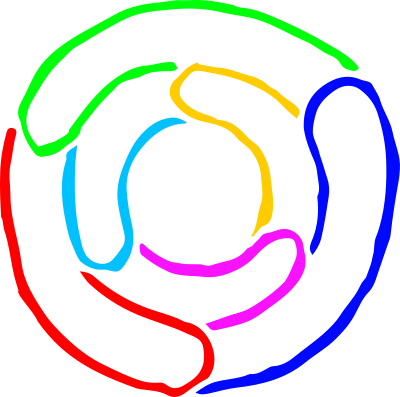
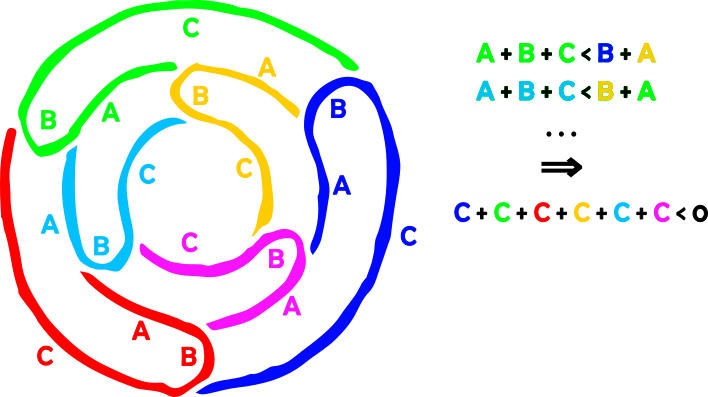
Alas, it turns out to be wrong, and Janos and I found that there are examples where the carefully named and arranged streets are not the shortest. And the aesthetically pleasing example you see here:

It is not hard to see that we cannot give a length metric to this graph such that each of the colored lines is a shortest path; here is the calculation:

And as streets should not have negative length, we are out of luck.

Disclaimer: updates to the post were sponsored by an anonymous professor at Rényi Institute