Shakshuka and paying the bill

I had lunch with László Babai yesterday, and he asked me the following problem. I changed it up a little to make it less findable online (though I did not find the problem in this variant).

Say you have shakshuka with a friend every Monday at the same restaurant. The meal is always the same, but the price can vary every week; the restaurant adjusts it to market prizes for the many vegetables that enter the dish (shakshuka literally means something like mixed stuff from the market). There is no way of knowing what the prizes next week will be, and it can even be that the restaurant pays you a little for taking overdue vegetables from their hand.

Now your friend is quite gentlemanly, and every second week, he allows you to look at the check, and decide whether you want to pick up the bill, or let him do it, with the understanding that you alternate in the week after.

You are not such a polite person, and try to save money in a sneaky way. What should be your strategy?

Here, the strategy works even if your friend knows the strategy. And even if he has set the prices in advance for eternity.

It is one of those cases where your gutfeeling is correct.

The summer was subadditive, the fall is ?-positive

The summer and spring was quite eventful and interesting, aside from lazy rhymes. Apart from exciting new work that I will talk about later, I just submitted a paper that proves subadditivity of shifts in minimal resolutions:

Given a homogeneous ideal I in a polynomial ring S, the quotient S/I admits a minimal resolution; a way of writing S/I at the end of an exact sequences involving shifted copies of S; the maximal shift in place i is denoted by t_i.

Herzog and Srinivasan proved that, for monomial ideals,

t_{a+1} \le t_{a} + t_1

and Avramov, Conca and Iyengar conjectured that

t_{a+b} \le t_{a} + t_b.

This is false already for binomial ideals, though, as Ein and Lazarsfeld showed. But for monomial ideals I showed it is true. In the end, it is a quite beautiful reduction to a vanishing theorem for lattices (as in, poset lattices) and a bit of of Eilenberg-Zilber shuffle products. You can grab the paper here.

Currently working on a rather cool construction due to Danzer. Incidentally, Ludwig Danzer is one of the first professors I had in a class (he taught a course in tiling theory that I attended) and I fell in love recently with a construction of his: given a simplicial complex X, he constructs a cubical complex such that the neighborhood of every vertex is isomorphic to X. If X is the clique complex of a graph, this cubical complex has the fundamental group that is the commutator of the associated right-angled Coxeter group. And the cohomology ring is quite interesting indeed. More later.

Aside from that, travels to Greece (marvelous new projects with Vasso Petrotou and Stavros Papadakis), Beijing (amazing conference organized by Yau) and Los Angeles (working with Igor).

Reason and Reasonability

The past few weeks/months/years have been interesting to say the least; and all surrounds the recent activities surrounding basic laws; my colleague David Enoch summarizes the situation here quite well.

I will leave it to him to explain it, and just add a sideobservation: Even though the struggle is against an eroding of constitutional principles in Israel primarily, I have the entirely subjective feeling that also discussions of the occupation and relations to the Palestinians have become more commonplace; perhaps it is the prospect of losing civil liberties, or it is awakening to the slowly increasing temperature in the cookpot, but I feel many discussions have been more open; and though there is more fighting among colleagues and friends, I also appreciate how alive and democracy are, not in the Knesset, perhaps, but on the street protesting.

Jewish Poker

For quite a while the two of us sat at our table, wordlessly stirring our coffee. Ervinke was bared. All right, he said. Let’s play poker.

No, I answered. I hate cards. I always lose.

Who’s talking about cards? thus Ervinke. I was thinking of Jewish poker.

He then briefly explained the rules of the game. Jewish poker is played without cards, in your head, as befits the People of the Book.

You think of a number, I also think of a num­ber, Ervinke said. Whoever thinks of a higher num­ber wins. This sounds easy, but it has a hundred pit­falls. Nu!

All right, I agreed. Let’s try.

We plunked down five piasters each, and, leaning back in our chairs began to think of numbers. After a while Ervinke signaled that he had one. I said I was ready.

All right, thus Ervinke. Let’s hear your number.

Eleven, I said.

Twelve, Ervinke said, and took the money.

I could have’ kicked myself, because originally I had thought of Fourteen, and only at the last moment had I climbed down to Eleven, I really don’t know why. Listen. I turned to Ervinke. What would have happened had I said Fourteen?

What a question! I’d have lost. Now, that is just the charm of poker: you never know how things will turn out. But if your nerves cannot stand a little gam­bling, perhaps we had better call it off.

Jewish Poker by Ephraim Kimshon

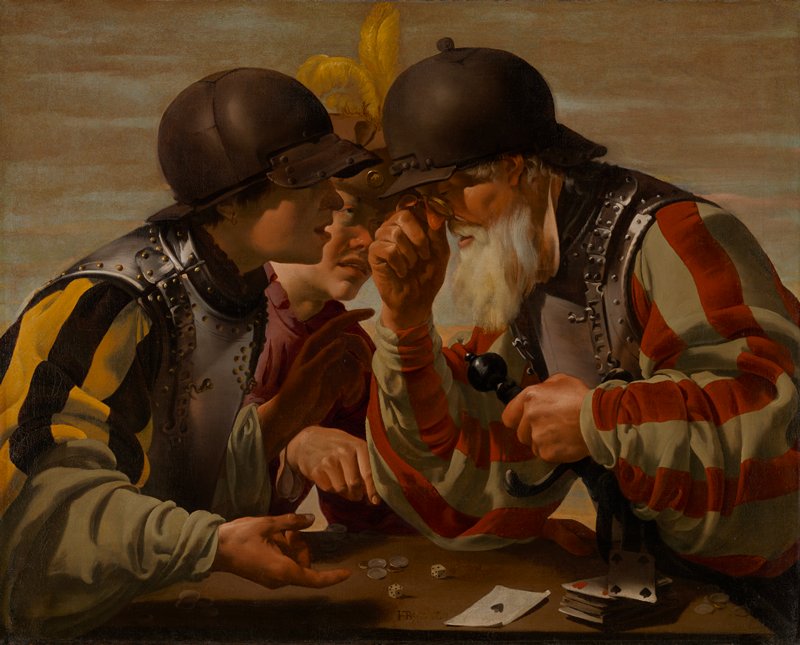
What just happened? by Hendrick ter Brugghen
Continue reading

It just piles up

This is the third in line of three posts about “worldly” problems, with the diplomacy one here and the diversity one here. I will probably also write one on freedom of expression at another point, which is a different topic important to me, but you know, this entire site is an exercise in speaking my mind on whatever I want. Needless to say, this is different from mathematics in that the problems are often trivially solved, but the implementation often comes with resistance. I mean, outside of alphabet agencies, a mathematical theorem rarely endangers your life. Well commutative algebra does. And you know, having both in your life is kind of nice 😉

In a small update to this post, I remember visiting a spring next to Jerusalem, in Lifta, with a dear friend. It is small and beautiful, and close to one of my favorite works of architecture, that impressively greets you once you enter my favorite place in the world.

But of Lifta, I mostly remember one thing: The ungodly amounts of trash that were littered in and around the spring. There is a clear issue in that once it reaches a level of visibility, people tend to loose all morals and just add to it.

Continue reading

Can animals recognize symmetry? A foolish idea for a few seconds

Here is how stupid thoughts are made: I read a post by my friend Michael Kapovich about succulents that evolution made look like stones to avoid animals that might feed on them.

Lithops

My first thought was: those are just colorful, beautiful butts.

My second thought: It makes me actually wonder: from a human perspective, we immediately recognize the symmetry and see that this is not a stone. To be evolutionarily effective, that must mean that animals, for the most part, may not recognize symmetry. Antisymmetry must not have an advantage when it comes to camouflage. Which led me to find out that symmetry and its recognition is barely understood in either way, but that I may also be stupid because in real life these plants may look less symmetric. Still, maybe there is something about it.

Continue reading

Not because it is easy…

and not because it is hard either.

A few years ago there was a heated discussion about diversity statements, initiated by an opinion by my friend Abby. And I felt that either way, either side missed a critical point. A quick overview: Diversity statements are a requirement that some universities, some science foundations and some companies require. Abby argued against them, some people argued for her, some against. All in all, it was kind of ugly.

And what is really the issue, the real culprit, the thief in the night, could just get away.

Because you see, universities, governments, companies etc. can say that they required a diversity statement, and they are done. That they imposed a quota for the organization or attendance of a conference, and they did their duty. Alas, the hard part, to actually enable participation, is usually not given. It is not easy for a parent to juggle childcare and studies, it is not easy for a disadvantaged person to attend a conference or workshop or university in the first place.

Continue reading

What I (also) talk about when I talk about struggling

In reference to some recent posts like this and nightlong discussions with Dasha Poliakova, I wanted to clarify a metapoint of why I actually made the post. And there is a point besides the point of me actually struggling, or me dying to those Rune Bears or difficult exploration projects.

It is that I am aware that I am, even if a strange person, in a position of power. And as such, people look up to someone like me, whether it is with hate or admiration. I additionally have some power over my employees, what happens in my field etc. I certainly don’t feel that way, but I understand that I can be intimidating.

Hence talking about struggling is not actually only talking about struggling. It is also serves a higher objective, in that it shows it is okay to struggle, and it is ok to talk to me about struggling. I think the former is just evidently good, the latter is more subtle. But I have made the experience (on myself and others) that a struggling person in your care is still very capable of hiding, of subterfuge and of distraction, wasting much more of their time on trying to distract you with presents or niceties you than on getting better. Hence, you (as a person encountering someone struggling) may not notice anything, or think everything is fine. Especially if they are scared of you, because they perceive you as authority (even if you feel just as small yourself).

I do not make up a struggle, and you should not either. You do not have to emulate the specific struggles of your students. It can be something as simple to admitting you are struggling to understand a paper today, or have trouble figuring out a problem (not that not understanding that paper is entirely your fault). It shows those around you and under your care that you have experience with it.

And again, there is a metapoint to this post: if you are in a position of power, if you have people under your care, this might be something for you to consider. Plus you can do it from bed at 5pm while frustrasted and laying down a paper about analytic torsion (or just still snuggling).