The one where some mathematicians meet on Lesbos, and observe that all F-pure standard graded Gorenstein rings have the hard Lefschetz property, but some Gorenstein domains do not.
A pipe dream refers to a fantasy that is unlikely to materialize, something that is out of reach. It appears, according to etymologists at least, to originate as a racist (anti-chinese) term in sensational press in relation to opium dens around the end of the 19th century.
Historical racism aside, I am referring to overly optimistic conjectures guided by the vague dream that nice objects should behave nicely. Often, these conjectures arise from a lack of counterexamples, rather than a genuine insight of how this might come to pass. For this post, I am referring here to a specific, and ubiquitous feeling that many in commutative algebra and combinatorics seem to share: A standard graded Gorenstein ring that is “as free as possible” should satisfy the Lefschetz property after a generic Artinian reduction 1,2. For instance, the universal conjecture seemed to be the central theme of this post:
Magnificent Conjecture3: (Standard graded commutative) Gorenstein domains have the Lefschetz property:
i.e. Take a sufficiently general linear system of parameters, and the quotient will have the Lefschetz property with respect to a generic degree one element.
This magnificent conjecture is attractive, because it would include various now proven conjectures for generic Lefschetz properties in simplicial spheres, lattice polyopes and more.4 And it therefore would explain, in one fell swoop, many situations at once. An attractive generalization… and sadly, the wrong one.
Generic Lefschetz theory is the similarly utopian belief that some objects inspired by algebrao-geometric objects, but capturing more general behaviours, should satisfy the Lefschetz property. The motivation is usually either from commutative algebra, or from combinatorics, as the Lefschetz property has desirable consequences. It has seen some successes recently, for face rings in arbitrary characteristic5 and for semigroup algebras of lattice polytopes in characteristic two6.
The latter is particularly interesting for the purposes of this post: The former paper introduced the idea of using non-degeneracy of Poincare pairings at subspaces, and showed it equivalent to Lefschetz properties using a lifting lemma based on suspensions I discovered. Papadakis and Petrotou built on this and observed that in characteristic two, a stronger property holds: over a generic Artinian reduction (meaning, the coefficients of the linear system of parameters are algebraically independent), the Poincare pairing is nondegenerate at all principal ideals (this we call total anisotropy). This amazing simplification opened up all kinds of other routes, because it is easier to prove. Papadakis and Petrotou in particular observed that for simplicial spheres, there are simple differential identities on the volume polynomial (a parametrization of the fundamental class) that prove total anisotropy.
The plot thickens
In our work on lattice polytopes, we introduced a non-homogeneous identity that describes the volume polynomial. Because of its similarity to identities found in analysis, specifically those of the Parseval-Rayleigh type, we called them the Parseval-Rayleigh identities of the semigroup algebra associated to a lattice polytope, and used them to prove anisotropy, and therefore the Strong Lefschetz property in this setting. And we dreamed on… perhaps, in the distance, we could perceive of Stanley Conjecture.
I would say, at this point, it went from a pipe dream to a mirage. Something that we see in the distance, but is probably much further than we would like it to be.
And then we worked on. We found that some parts of the techniques applied to general rings7 and some more extended to complete intersections8. Until recently Mykola Pochekai, and in a parallel development also we (with Eric), discovered the connection to Frobenius twists and therefore that Parseval-Rayleigh identities hold for general standard graded Gorenstein rings9 (and a bit more) in characteristic p>0. More importantly, our paper contained in addition a very nice observation of Ryoshun Oba, who generalized and conceptualized10 earlier efforts to axiomatize anisotropy11 into a notion of p–conductivity.
And then, our conference in Mytilene happened.
ἀναγνώρισις/ἁμαρτία12
Three things were realized, two of them are quite immediate corollaries of the paper on Frobenius identities. I stay in characteristic two, where the main action takes place, and refer to that paper for references.
First, let us return to the notation of our paper: It turns out that the Parseval-Rayleigh identities are related to a certain polynomial which we call the Parseval core supported in the underlying ring. Let us call it H. Conductivity we mentioned earlier is tied to this polynomial.
And three things were observed. First, Joel Hakavuori observed that the natural notion called F-purity implied what we called 2-conductivity for H. And therefore, the following is an immediate corollary of Proposition 4.3.
Theorem Any F-pure standard graded Gorenstein ring is totally anisotropic, and therefore has the hard Lefschetz property.
This is quite immediate from Fedder’s criterion for F-purity. The theorem is quite magnificent: Face rings are F-pure, so Joel had just given a beautiful perspective and proof of the g-conjecture in characteristic two. And since lattice rings are F-pure as well, this included the Ohsugi-Hibi conjecture as well. But F-purity is much richer still… it includes regular rings; split subrings/direct summands, especially invariant rings; Feddertest hypersurfaces and complete intersections; determinantal, Pfaffian, symmetric, Hankel, Schubert determinantal rings; section rings of Frobenius split varieties, especially flag/Schubert and ordinary abelian varieties; and of course the aforementioned seminormal monoid rings and toric face rings. All of these suddenly satisfied the hard Lefschetz property with respect to a generic Artinian reduction.
The second observation is more subtle: The principal ideal (H) has a Frobenius root13 . Ryoshun refined his understanding of conductivity further, and showed, again in an immediate but impressive refinement of Proposition 4.3:
Theorem Assume R is F-pure standard graded Gorenstein with socle degree d. Then a generic Artinian reduction is totally anisotropic if and only if the image of generates the degree part of some Artinian reduction of R.
This is a complete characterization… and quite beautiful at that. We don’t have a name yet (ask me again in a week) but one could call such objects F-wide, perhaps.
Anyway, all this invigorated me to find counterexamples to the original magnificent conjecture, that days before, I had believed. And this is the hamartia of our story. After all, now that we understood what really made these rings tick… maybe asking the ring to be a domain was just the wrong thing to ask? And indeed, that is the case: And thanks to Ryoshun’s criterion, I knew where to look.
Theorem Consider the quotient of by the ideal generated by polynomials . For any n, this is a Gorenstein complete intersection, and an integral domain.
For n=5, it does not have the weak Lefschetz property (and in particular, not the hard Lefschetz property) with respect to any Artinian reduction.
Denouement?
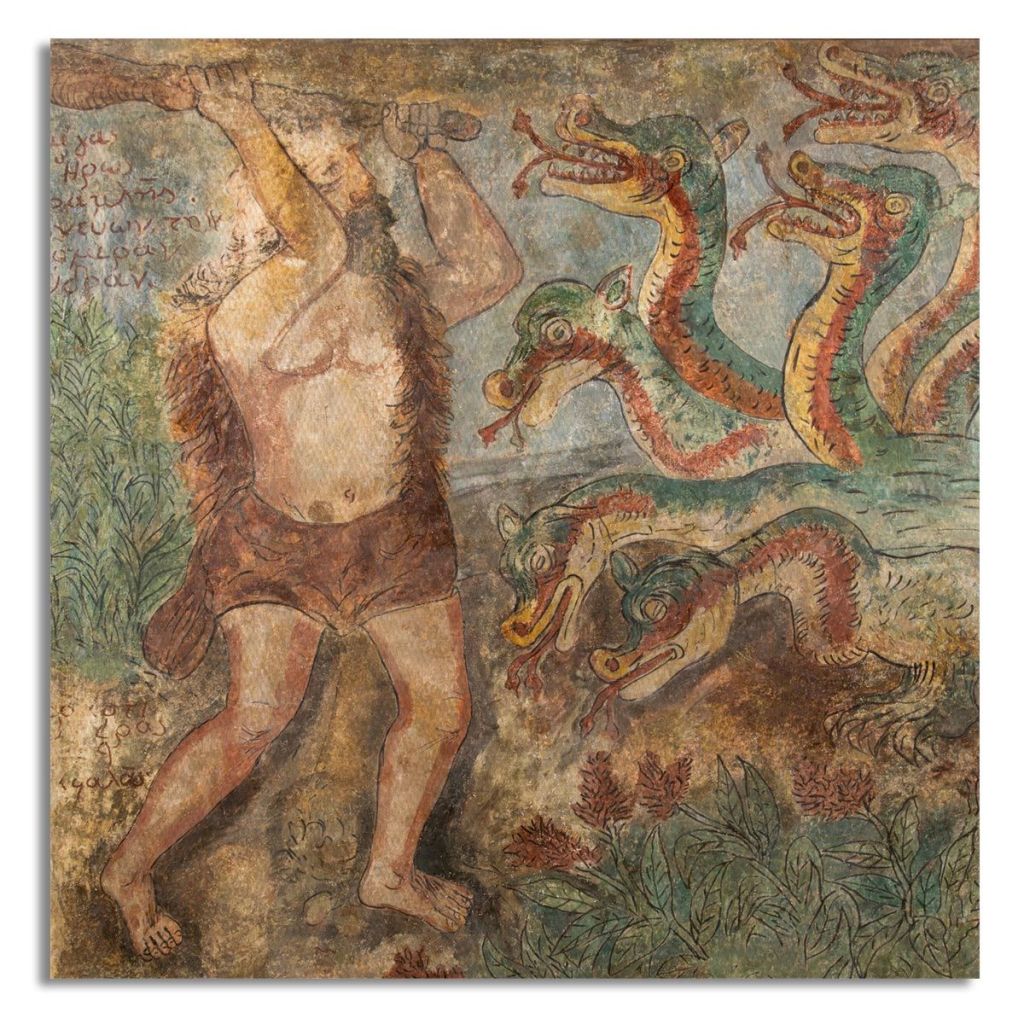
Is there ever a final untangling in mathematics? Probably not. Math is like a beautiful, ever self-assembling knot, which, even if you untie it somewhere, some other part appears, ever more tangled. So… questions remain. This illuminates the understanding of generic Lefschetz properties in characteristic two, to some degree. But in characteristic not equal to two… many questions remain. Are there Gorenstein domains without the Lefschetz property? What is the right replacement for F-purity in characteristic zero? The hydra remains unslain.
- Stanley, R.P.: Log-concave and unimodal sequences in algebra, combinatorics, and geometry. In: Graph theory and its applications: East and West (Jinan, 1986), Ann. New York Acad. Sci., vol. 576, pp. 500–535. New York Acad.
Sci., New York (1989). DOI 10.1111/j.1749-6632.1989.tb16434.x. ↩︎ - Juan Migliore and Uwe Nagel, A tour of the weak and strong Lefschetz properties, J. Commut. Algebra 5 (2013), no. 3, 329–358., specifically Question 6.8 ↩︎
- I call it magnificent conjecture to refer to it by one name here, but it really was asked several times in different forms as the references above indicate. ↩︎
- It is often that mathematicians, when faced with a conjecture they cannot solve, come up with a more general conjecture they can solve even less. ↩︎
- The Lefschetz property for face rings, hal.science/hal-05575100v2 ↩︎
- Lattice polytopes and semigroup algebras: Generic Lefschetz properties and Parseval-Rayleigh identities, hal.science/hal-05238822v2 ↩︎
- The volume intrinsic to a commutative graded algebra, hal.science/hal-04661500v1 ↩︎
- Parseval-Rayleigh identities for homogeneous complete intersections ,hal.science/hal-05354563v1 ↩︎
- Parseval-Rayleigh identities for graded Artinian Gorenstein algebras, arxiv.org/abs/2604.27631 and Frobenius identities for the volume map on Cohen–Macaulay rings, hal.science/hal-05610832v1 ↩︎
- Section 4.1 in our Frobenius identities paper ↩︎
- Combinatorial Lefschetz theorems beyond positivity II: Total anisotropy, hal.science/hal-05124466v1 ↩︎
- I was considering the title “The plot Frobenius twists” here ↩︎
- Discreteness and Rationality of F-Thresholds, arxiv.org/pdf/math/0607660 ↩︎

