The g-theorem describes the face numbers of simplicial polytopes (and homology spheres over a field) as being described better in terms of a g-vector; and it says more precisely that this vector is always nonnegative and cannot grow to fast, that is, cannot be too large in terms of .
Now, one can ask: How are these numbers related to the shape of a polytope? Indeed, a number of years ago, we found out that polytopes that approximate a smooth convex body well cannot be too close to the lower bound; that is, with the exception of the trivial first entry, the entries of the g-vector had to grow.
But could they be close to the maximal growth? That remained an open question, and I hoped a quantitative Gotzman persitence type theorem would shed light on the situation.
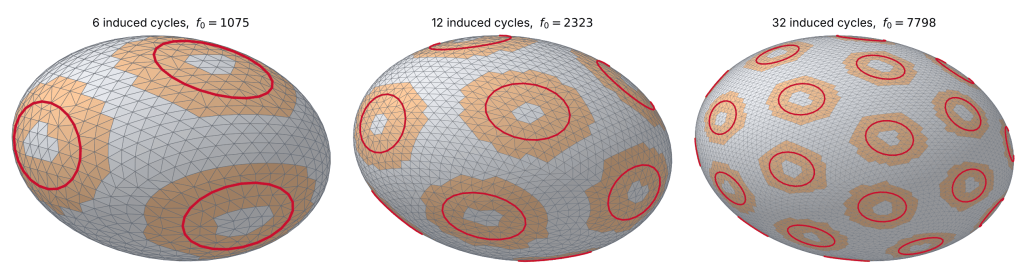
Turns out that is not needed. Joel Hakavuori now answered this question in a very beautiful and elegant way, only relying on the fact that in any polytope approximating a smooth convex body, many induced cycles exist in the boundary… and more and more as the approximation gets better. You find the paper here.

Roughly: on a polytope close to a smooth body one can find many induced cycles (homologically full spheres) 


The question is then how many can arise as derivatives of stresses one degree up. If 


Adding the two gives 


In short: far-apart local stresses behave like monomials in disjoint sets of variables, which is the opposite of a compressed set, so the 
Fine work!


You must be logged in to post a comment.