I wanted to quickly mention an “almost” LLM result. I wrote previously about a marvelous new approach of Yuchen Bi to Stoker’s conjecture using differential geometry, but that still critically used quite extensively non-polyhedral techniques. Yesterday, Arseniy Akopyan wrote to me that he chatted with LLM and found a polyhedral only proof.
Not essentially new, Arseniy and I then noticed that the LLM had “stolen” a result of Martin Winter, who in 2023 found the proof without noticing, and wrote it in a very nice paper expanding our knowledge of Wachspress coordinates and Izmestiev matrices. Congratulations, Martin!

The initial manuscript of Arseniy+LLM was longer, but spent most of its time reproducing a Lemma Martin had in his paper (giving the same proof as him, so I assume it “stole” without being fully aware). So, with that Lemma in mind, the proof is actually trivial. Martin has prepared a short note and allowed me to share it here.
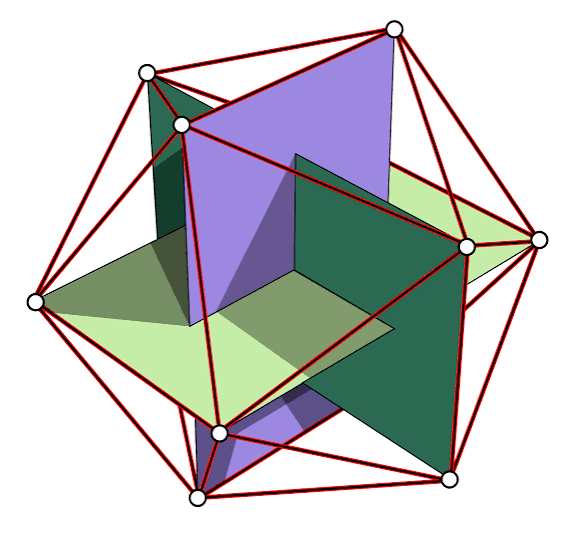
An icosahedral rational homology 3-sphere.
I want to at this stage remind everyone of one my favorite open problems: Is there a 4-polytope all whose facets are icosahedra. It is still open. For all other regular polytopes, we know whether such a polytope having it as its only facet exists.
The problem, I realized early on, is that the techniques cannot generalize. They all rely on homological properties only, and I realized early on that there are homology 3-spheres every facet of which is an icosahedron. The construction is standard, but I wanted to record it here.
Let
![\Delta=[3,5,3]^+ =\langle a,b,c\mid a^3=b^5=c^3=(ab)^2=(bc)^2=(abc)^2=1\rangle .](https://s0.wp.com/latex.php?latex=%5CDelta%3D%5B3%2C5%2C3%5D%5E%2B+%3D%5Clangle+a%2Cb%2Cc%5Cmid+a%5E3%3Db%5E5%3Dc%5E3%3D%28ab%29%5E2%3D%28bc%29%5E2%3D%28abc%29%5E2%3D1%5Crangle+.+&bg=ffffff&fg=333A42&s=0&c=20201002)
Define an epimorphism 


Put 


the complex has 


Consequently

and hence
The group-theoretic quotient is from G. A. Jones, C. D. Long and A. D. Mednykh, Hyperbolic manifolds and tessellations of type {3,5,3} associated with L2(q), arXiv:1106.0867.

